I Found My 1999 Undergraduate Thesis: What Does It Have to Do with BIM?
Originally published in 2015. References to events, registration, prices and professional profiles in this part of the post belong to that period. TI Lab became EBBIM, Empresa Brasileira de BIM, in 2020. Its current website is www.ebbim.com.br.
"The redevelopment of an urban area shaped by a railway and a river in Cruzeiro, in the interior of São Paulo state. More than just elements with a striking presence in any landscape, in this case they appear as determining factors in the emergence of the city, defining its character, guiding its growth, and being part of its history. However, the city today seems to have forgotten the importance of the river and the railway, running over them with viaducts and bridges, as if they were obstacles, undesirable elements that can't be gotten rid of. This project discusses these relationships and what can be done to make the city look back toward the river and the railway."
That is the opening text of my Final Undergraduate Thesis at FAU USP - Faculdade de Arquitetura e Urbanismo, in 1999, under the guidance of Prof. Dr. Silvio Macedo.
It all started with a request from Tamyse Campos, a student at FAU FATEA, in Lorena, São Paulo, and thanks to the help of Felipe Barradas, who works with me at EBBIM and went to the FAU-USP library to pick up the material, I managed to recover a good part of the project!
Alright, you're probably asking: what does this have to do with BIM?
Well, the model was built entirely in Vectorworks 8, in 2D and 3D simultaneously. Although it wasn't the focus of the project (and doesn't appear on the drawing sheets), I had (and still have) access to the table of planted species and the number of square meters designed for each type of ground cover.
The entire model is integrated, and I had the chance to render it in Artlantis, using the reference-update feature, so the design model could update the render model whenever needed.
All of this was still quite hard to do back then—the machines were very slow—but it wasn't impossible.
If you're curious, feel free to take a look :-)
I made some pretty large JPEGs, but they don't display properly. So I put the images in high resolution at this Dropbox link.
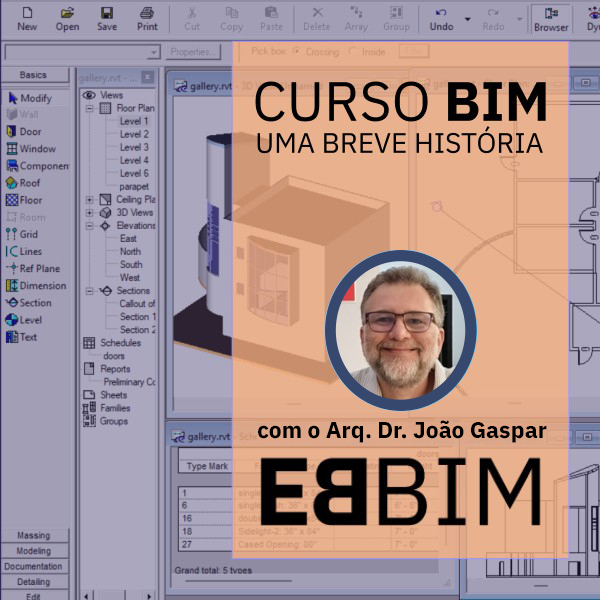
Would you like to deepen your knowledge of the origins and evolution of BIM? Explore EBBIM’s Curso BIM – Uma breve história – anos 1960 a 2000. The training covers pioneers, early commercial applications and the evolution of design systems from 1960 to 2000, complementing the topic of this post.
Historical references: the links below lead to copies of the original pages preserved by the Internet Archive. Downloads, forms and registration on these copies may not work; these references are retained as a record of the publication period.
- Curso de Arquitetura e Urbanismo — 05/04/2016
Historical record: the old Facebook links associated with Tamyse Campos and Felipe Barradas are no longer available. Their names and this account have been retained to preserve the record of the collaboration that made recovering this work possible.
Gallery recovered from the original post on O BIM e o mar. Click the images to open the original high-resolution files.