How Is BIM in Brazil Evolving Compared to the Rest of the World?
·4 min read
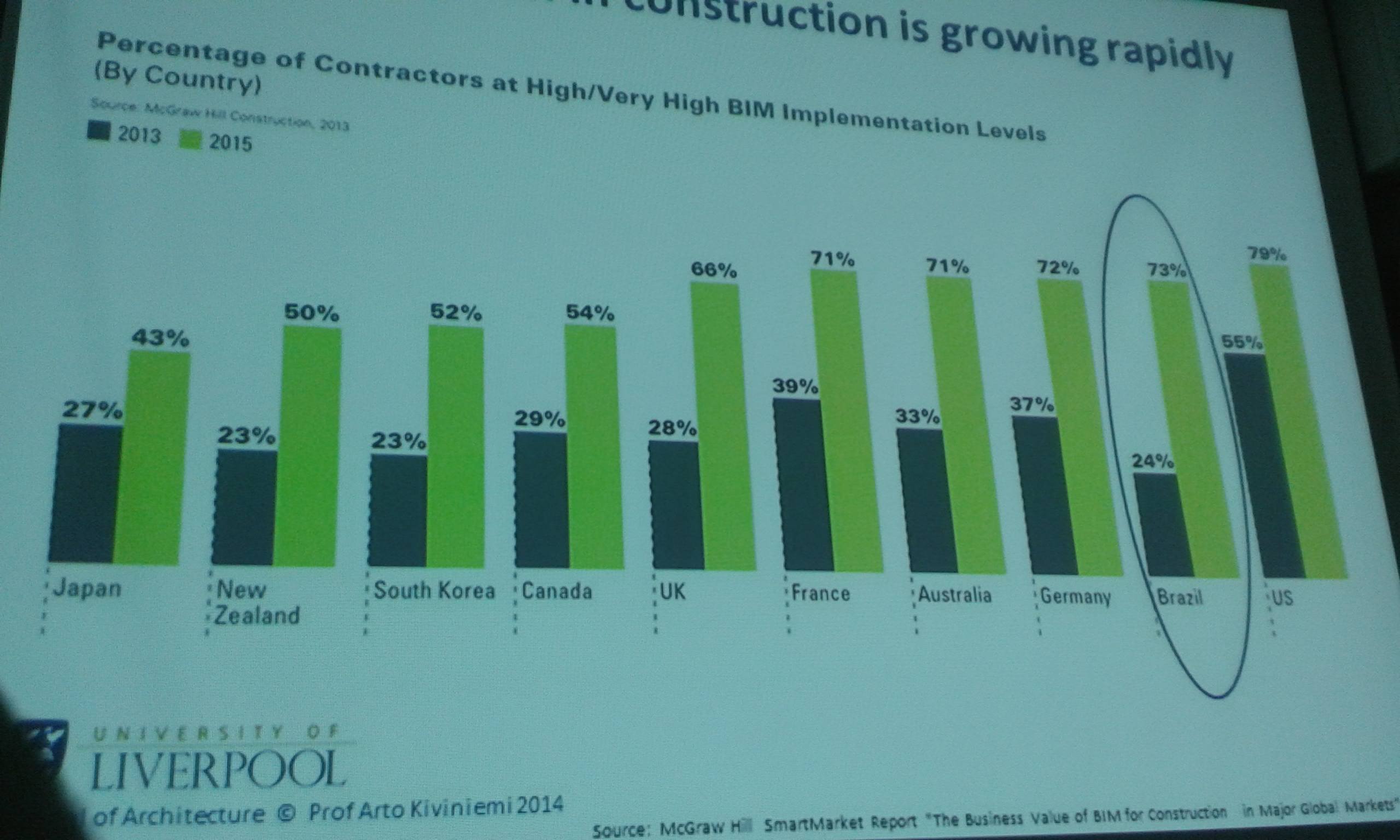
In the post "O primeiro encontro - parte II" on this blog, I show some images from professor Arto Kiviniemi's talk, which was about the evolution of BIM. Looking back at the post (and redoing some of the captions) I remembered an image that had caught my attention. In it, the professor displayed a chart in which Brazil appeared with a high adoption level of BIM at 24% in 2013, expected to rise to 73% in 2015. Amazing, isn't it? Take a look:
[caption id="attachment_63" align="alignnone" width="300"] Kiviniemi points out that, according to a McGraw Hill survey, 73% of Brazilian companies state that they will have BIM highly implemented by 2015. Will they, though?[/caption]
Very well. Looking at the fine print in the caption, I saw that the information had been taken from a survey published in January 2014 by the well-established American consulting firm McGraw-Hill Construction.
[caption id="" align="alignleft" width="363"] Report on the global BIM landscape in 2014 by McGraw-Hill. You can click the image to download it, which is free (but it's in English, mind you...). You have to fill out an annoying form, but it's OK. Besides the report's text, the charts are very good, so even if English isn't your strong suit, it's worth it![/caption]
The report, called Business Value of BIM for Construction in Major Global Markets SmartMarket Report, is highly respected throughout the BIM community, from academics to industry professionals. According to the words that summarize the goal of the research (which I translate here), the report "reveals the BIM-related value perceived by the industry in nine of the world's largest construction markets: Australia/New Zealand, Brazil, Canada, France, Germany, Japan, South Korea, the United States, and the United Kingdom. The report offers insights, both globally and market by market, into the profile of who is using BIM, the benefits and return on investment derived from their BIM investments, and how much BIM contributes to their most critical activities and practices. Specific evaluations of the responses, by region, also provide a basis for understanding the current use of BIM and its future potential worldwide".
Well, so what?
So, studying the report gives you a sense of how BIM implementation is evolving in Brazil and around the world, but of course only up to a point. Since the report is basically the result of a survey answered by human beings like us, the data has to be interpreted very carefully.
Let's see: as I wrote at the beginning of the text, and I repeat now, on page 12 of the report there's a chart in which Brazil appeared with a high adoption level of BIM at 24% in 2013, rising to an expected 73% in 2015.
Is that true, though? Is 24% in 2013 a little, or a lot? And is 74% in 2015 a lot, or a little?
More importantly, what does the phrase "high or very high levels of BIM implementation" actually mean?
Do the Brazilian survey participants even know what that means? Is it enough to just use Revit, or TQS, for a company to declare itself using BIM at a high level?
That's the thing. My suspicion is that, both here and in the rest of the world, very few people know how to measure a company's level of BIM implementation in a scientific way.
[caption id="attachment_132" align="aligncenter" width="660"]
Report on the global BIM landscape in 2014 by McGraw-Hill. You can click the image to download it, which is free (but it's in English, mind you...). You have to fill out an annoying form, but it's OK. Besides the report's text, the charts are very good, so even if English isn't your strong suit, it's worth it![/caption]
The report, called Business Value of BIM for Construction in Major Global Markets SmartMarket Report, is highly respected throughout the BIM community, from academics to industry professionals. According to the words that summarize the goal of the research (which I translate here), the report "reveals the BIM-related value perceived by the industry in nine of the world's largest construction markets: Australia/New Zealand, Brazil, Canada, France, Germany, Japan, South Korea, the United States, and the United Kingdom. The report offers insights, both globally and market by market, into the profile of who is using BIM, the benefits and return on investment derived from their BIM investments, and how much BIM contributes to their most critical activities and practices. Specific evaluations of the responses, by region, also provide a basis for understanding the current use of BIM and its future potential worldwide".
Well, so what?
So, studying the report gives you a sense of how BIM implementation is evolving in Brazil and around the world, but of course only up to a point. Since the report is basically the result of a survey answered by human beings like us, the data has to be interpreted very carefully.
Let's see: as I wrote at the beginning of the text, and I repeat now, on page 12 of the report there's a chart in which Brazil appeared with a high adoption level of BIM at 24% in 2013, rising to an expected 73% in 2015.
Is that true, though? Is 24% in 2013 a little, or a lot? And is 74% in 2015 a lot, or a little?
More importantly, what does the phrase "high or very high levels of BIM implementation" actually mean?
Do the Brazilian survey participants even know what that means? Is it enough to just use Revit, or TQS, for a company to declare itself using BIM at a high level?
That's the thing. My suspicion is that, both here and in the rest of the world, very few people know how to measure a company's level of BIM implementation in a scientific way.
[caption id="attachment_132" align="aligncenter" width="660"] cover of professor Bilal Succar's blog, one of the researchers who understands BIM best in the world[/caption]
Luckily for me, a few months ago, within days of each other (and under different circumstances), professors Adriano Sales and Leonardo Manzione pointed me to the blog of professor Bilal Succar, who, among other excellent work, developed a scientific method for measuring a company's BIM Maturity level. Click here to access the post on his blog, where Succar explains the method in summary form. If you prefer, download the full article, available here.
So, if I were McGraw-Hill, in the future I would include a question along these lines:
According to the method developed by prof. Succar, how is BIM implementation assessed in your company?
Of course the answer to a question like that isn't simple, but for now it would be the only truly rigorous method of assessment that I know of. As for the rest...
cover of professor Bilal Succar's blog, one of the researchers who understands BIM best in the world[/caption]
Luckily for me, a few months ago, within days of each other (and under different circumstances), professors Adriano Sales and Leonardo Manzione pointed me to the blog of professor Bilal Succar, who, among other excellent work, developed a scientific method for measuring a company's BIM Maturity level. Click here to access the post on his blog, where Succar explains the method in summary form. If you prefer, download the full article, available here.
So, if I were McGraw-Hill, in the future I would include a question along these lines:
According to the method developed by prof. Succar, how is BIM implementation assessed in your company?
Of course the answer to a question like that isn't simple, but for now it would be the only truly rigorous method of assessment that I know of. As for the rest...
Kiviniemi points out that, according to a McGraw Hill survey, 73% of Brazilian companies state that they will have BIM highly implemented by 2015. Will they, though?[/caption]
Very well. Looking at the fine print in the caption, I saw that the information had been taken from a survey published in January 2014 by the well-established American consulting firm McGraw-Hill Construction.
[caption id="" align="alignleft" width="363"] Report on the global BIM landscape in 2014 by McGraw-Hill. You can click the image to download it, which is free (but it's in English, mind you...). You have to fill out an annoying form, but it's OK. Besides the report's text, the charts are very good, so even if English isn't your strong suit, it's worth it![/caption]
The report, called Business Value of BIM for Construction in Major Global Markets SmartMarket Report, is highly respected throughout the BIM community, from academics to industry professionals. According to the words that summarize the goal of the research (which I translate here), the report "reveals the BIM-related value perceived by the industry in nine of the world's largest construction markets: Australia/New Zealand, Brazil, Canada, France, Germany, Japan, South Korea, the United States, and the United Kingdom. The report offers insights, both globally and market by market, into the profile of who is using BIM, the benefits and return on investment derived from their BIM investments, and how much BIM contributes to their most critical activities and practices. Specific evaluations of the responses, by region, also provide a basis for understanding the current use of BIM and its future potential worldwide".
Well, so what?
So, studying the report gives you a sense of how BIM implementation is evolving in Brazil and around the world, but of course only up to a point. Since the report is basically the result of a survey answered by human beings like us, the data has to be interpreted very carefully.
Let's see: as I wrote at the beginning of the text, and I repeat now, on page 12 of the report there's a chart in which Brazil appeared with a high adoption level of BIM at 24% in 2013, rising to an expected 73% in 2015.
Is that true, though? Is 24% in 2013 a little, or a lot? And is 74% in 2015 a lot, or a little?
More importantly, what does the phrase "high or very high levels of BIM implementation" actually mean?
Do the Brazilian survey participants even know what that means? Is it enough to just use Revit, or TQS, for a company to declare itself using BIM at a high level?
That's the thing. My suspicion is that, both here and in the rest of the world, very few people know how to measure a company's level of BIM implementation in a scientific way.
[caption id="attachment_132" align="aligncenter" width="660"] cover of professor Bilal Succar's blog, one of the researchers who understands BIM best in the world[/caption]
Luckily for me, a few months ago, within days of each other (and under different circumstances), professors Adriano Sales and Leonardo Manzione pointed me to the blog of professor Bilal Succar, who, among other excellent work, developed a scientific method for measuring a company's BIM Maturity level. Click here to access the post on his blog, where Succar explains the method in summary form. If you prefer, download the full article, available here.
So, if I were McGraw-Hill, in the future I would include a question along these lines:
According to the method developed by prof. Succar, how is BIM implementation assessed in your company?
Of course the answer to a question like that isn't simple, but for now it would be the only truly rigorous method of assessment that I know of. As for the rest...